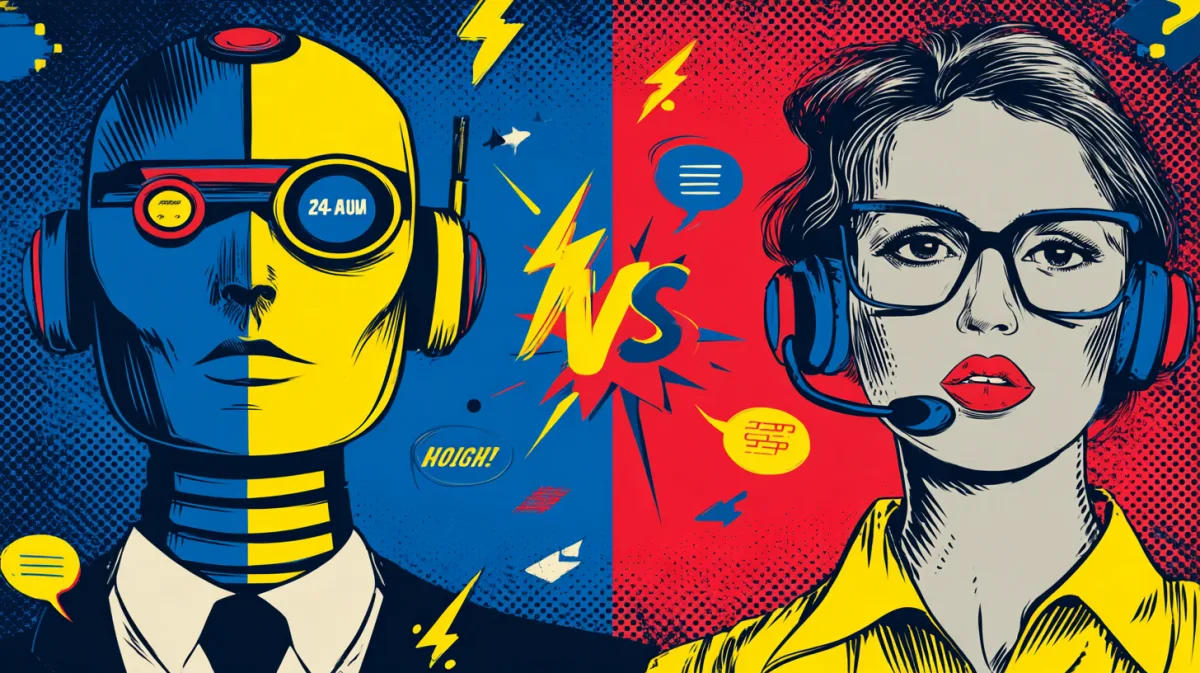
The AI chatbot vs live chat debate is everywhere right now. Every SaaS blog has a take. But most of them miss the point: it's not either/or. Most businesses in 2026 need both, and the real question is how much of each.
I've spent years building Boei's AI chatbot and live chat tools, and I've seen hundreds of businesses struggle with this decision.
TL;DR: Most businesses need both AI chatbot and live chat, not one or the other. AI chatbots handle ~70% of simple questions instantly at flat pricing ($11-200/month), while live chat excels at complex and emotional issues. The hybrid approach. AI handles first contact, humans handle escalations. Delivers the best customer experience. Boei includes both AI chatbot and live chat from $11/month with unlimited team seats.
Some go all-in on AI and frustrate customers with dead-end bot conversations. Others stick with live-chat-only and burn out their support team answering "what are your business hours?" for the thousandth time.
This guide covers the real differences between chatbots and live chat: cost, response time, customer satisfaction, scalability. And shows you how to combine both for the best results.
Before diving into the details, here's the high-level overview of how AI chatbots and live chat compare across the dimensions that matter most:
| Dimension | AI Chatbot | Live Chat |
|---|---|---|
| Response time | Instant (under 2 seconds) | 30 seconds to 10+ minutes depending on queue |
| Availability | 24/7/365 | Limited to agent working hours |
| Cost | Flat fee, typically $11-200/mo | Per-agent, typically $20-100/agent/mo |
| Simple questions | Excellent. Handles FAQs fast | Overqualified. Wastes agent time |
| Complex issues | Limited. Can struggle with nuance | Excellent. Empathy and judgment |
| Personalization | Good with training data | Great. Human intuition |
| Scalability | Handles 10 or 10,000 chats the same | Requires hiring more agents |
| Setup time | Minutes to hours | Days to weeks (recruiting + training) |
| Languages | Auto-translates to 100+ languages | Limited to languages agents speak |
| Customer satisfaction | High for quick answers | Higher for emotional/complex issues |
Neither column is all green. That's the point. Each approach has clear strengths and weaknesses, which is why the hybrid approach wins for most businesses. But let's break each one down first.
An AI chatbot is software that uses natural language processing (NLP) and large language models (LLMs) to understand customer questions and generate responses automatically. Modern AI chatbots in 2026 are not the rule-based bots from 2020 that could only match keywords. They actually understand context, remember previous messages in a conversation, and pull answers from your knowledge base.
A good AI chatbot trains on your website content, help docs, and product information. When a customer asks a question, the chatbot retrieves the relevant information and generates a natural, conversational response. A technique called Retrieval-Augmented Generation (RAG). If you're curious about the technical side, I wrote a detailed guide on how to build an AI chatbot.
Live chat is real-time messaging between a customer and a human support agent through a widget on your website. The customer types a message, a human reads it, and a human responds. It's the digital equivalent of walking up to a help desk.
Live chat has been around since the mid-2000s and remains the gold standard for complex customer interactions. Platforms like Intercom, LiveChat, Zendesk, and Boei all offer live chat functionality.
Now let's go deeper on each dimension, with real numbers where they exist.
This is where the chatbot vs live chat comparison gets interesting, because the cost models are fundamentally different.
AI Chatbot Costs:
Live Chat Costs (per agent, per month):
The math gets stark at scale. A 5-person support team on Intercom pays $195-495/month just for seats. On LiveChat, $100-295/month. On Boei, still from $11/month for the whole team.
For a detailed breakdown, see my chatbot pricing comparison for 2026.
Bottom line: AI chatbots win on cost, especially as your volume grows. Live chat costs scale linearly with team size. AI chatbot costs stay flat or grow slowly.
This is probably the single biggest difference between an AI chatbot and live chat.
AI Chatbot: Under 2 seconds. Always. At 3 AM on Christmas Day, same as Monday at 10 AM. No queue, no wait, no "please hold."
Live Chat: Varies enormously. Industry benchmarks suggest:
A SuperOffice study found that the average first response time for live chat is 2 minutes 40 seconds. 21% of live chat requests go completely unanswered.
For simple questions like "What are your pricing plans?" or "Do you support Shopify?", a 2-minute wait is absurd when an AI chatbot can answer instantly and accurately.
Bottom line: AI chatbots win on response time, hands down. This matters more than most businesses realize. 60% of customers say waiting on hold is the most frustrating part of service.
Simple questions are the bread and butter of customer support: pricing, feature availability, how-to instructions, business hours, return policies, shipping times.
AI Chatbot: Excellent. These questions have clear, factual answers that an AI trained on your content will nail every time. The chatbot doesn't need to think, consult a colleague, or look it up. It retrieves the answer and delivers it in seconds.
Live Chat: Overqualified. A human agent answering "What are your business hours?" is like using a Ferrari to drive to the mailbox. They'll give the right answer, but their time is wasted. This is the #1 cause of agent burnout. Repetitive questions that could easily be automated.
Research from Tidio suggests that 69% of customer queries are simple enough for a chatbot to handle. That means nearly 7 out of 10 conversations hitting your support team right now could be automated.
Bottom line: AI chatbots win for simple questions. Using human agents for FAQ-level queries is a waste of talent and money.
This is where the pendulum swings hard in the other direction.
AI Chatbot: Limited. Complex issues often require:
Current AI chatbots can handle some of this, but not reliably enough for high-stakes situations. A chatbot that confidently gives the wrong answer to a billing dispute is worse than no chatbot at all.
Live Chat: Excellent. A skilled human agent can:
For complex issues: refund disputes, technical troubleshooting, account recovery, complaints. Human agents consistently outperform AI.
Bottom line: Live chat wins for complex and emotional issues. Humans have judgment, empathy, and flexibility that AI can't reliably replicate yet.
AI Chatbot: Near-infinite scalability. An AI chatbot handles 1 conversation and 1,000 simultaneous conversations with the same speed and quality. A flash sale that 10x's your traffic? The chatbot doesn't even notice.
Live Chat: Linear scaling. More conversations means you need more agents. More agents means more seats, more salaries, more training, more management overhead. Seasonal spikes are especially painful. Do you hire temporary agents who won't know your product, or let wait times explode?
This is why the best AI chatbots for customer service are becoming essential for growing businesses. You can't hire your way out of a scalability problem.
Bottom line: AI chatbots win on scalability. If your business has growth ambitions, per-agent pricing will eventually become a bottleneck.
What do customers actually want? The data is more nuanced than either side likes to admit.
Key findings from recent research:
The takeaway: customers care about outcomes, not channels. They want fast, accurate answers. For simple questions, they're happy with AI. For complex issues, they want a human option. The worst experience is getting stuck in a bot loop with no way to reach a person.
Bottom line: It's a tie, but only if you offer both. Customers want AI speed for simple stuff and human help for complex stuff. Offering only one frustrates a significant chunk of your audience.
Here's what actually works in 2026: a hybrid approach where AI handles the first line of contact and seamlessly hands off to human agents when needed.
This isn't a theoretical ideal. It's how most successful customer support operations run today. And the data backs it up: businesses using hybrid AI + human support see 60% fewer tickets reaching human agents while maintaining or improving customer satisfaction scores.
Step 1: AI handles first contact. Every incoming message goes to the AI chatbot first. For the ~70% of questions that are simple and well-covered by your knowledge base, the conversation ends here. Customer gets an instant, accurate answer. Done.
Step 2: AI recognizes its limits. When the chatbot encounters something it can't handle confidently: a complex issue, an angry customer, a question outside its training data. It doesn't fake it. It says something like "Let me connect you with a team member who can help with this."
Step 3: Seamless handoff to human agent. The conversation transfers to a human agent in a shared inbox. Critically, the agent sees the full conversation history: what the customer asked, what the AI already tried, and any information collected. The customer doesn't have to repeat themselves.
Step 4: Human resolves the issue. The agent handles the complex conversation with full context. They can empathize, make judgment calls, and provide the personalized service that builds loyalty.
Step 5: AI learns. The best systems feed resolved conversations back into the AI's knowledge base. Over time, the chatbot gets better at handling edge cases, and fewer conversations need human intervention.
At Boei, this hybrid approach is built into the core product:
The key difference from most competitors: you don't pay extra for AI AND extra for live chat. Both are included. Most platforms charge a base fee for live chat, then add AI as a premium feature, then charge per AI resolution on top. That adds up fast. Check the pricing breakdown if you want the full comparison.
There's no universal answer here. Your choice depends on your business type, volume, and customer expectations.
Typical businesses: Small e-commerce stores, SaaS startups with good documentation, info-product businesses, booking/scheduling services.
Important: Even in an AI-only setup, give customers a way to reach a human. Even if it's just an email fallback. A bot loop with zero escape route is the fastest way to lose a customer.
Typical businesses: High-end consulting firms, financial advisors, luxury brands, B2B enterprise sales with long sales cycles.
Important: Even in a live-chat-only setup, consider using AI for after-hours coverage. A chatbot that can answer basic questions at 2 AM is better than a "we're offline, leave a message" form.
Typical businesses: Most SaaS companies, growing e-commerce brands, service businesses, agencies, education platforms. Basically, most businesses with an online presence.
For ideas on what an AI chatbot can do across different industries, check out AI chatbot use cases.
Neither is universally better. AI chatbots are better for speed, cost, scalability, and handling simple questions 24/7. Live chat is better for complex issues, emotional situations, and building personal relationships. The best approach for most businesses is a hybrid: AI handles first contact and routine questions, humans handle everything else. See our live chat features comparison for what to look for in a platform.
Not in 2026, no. AI chatbots can handle 60-70% of typical support conversations, but the remaining 30-40% still benefit from human judgment, empathy, and creative problem-solving. Fully removing humans risks frustrating customers with complex issues. The smartest strategy is to let AI handle the volume so your human agents can focus on conversations that actually need a human touch.
AI chatbots typically cost $11-200/month as a flat fee regardless of team size. Live chat platforms charge $20-100 per agent per month, so a 5-person team costs $100-500/month just for software. AI chatbot costs stay flat as you scale; live chat costs grow linearly with each hire. For a detailed comparison, see our chatbot pricing comparison.
It depends on the situation. Research shows 70% of customers are happy using a chatbot for simple questions, but 86% want the option to reach a human. About 40% don't care whether they're talking to AI or a person, as long as their problem gets solved. The key takeaway: offer both, and make the handoff seamless.
Industry best practice is a first response under 30 seconds. The average is about 2 minutes 40 seconds. Anything over 5 minutes and you're losing customers. AI chatbots respond in under 2 seconds, which is why using AI for first contact. Even if it just acknowledges the message and collects context. Improves the customer experience.
A hybrid chatbot combines AI automation with human live chat. The AI handles the initial conversation, answers simple questions, and collects information. When the conversation requires human judgment: complexity, emotion, edge cases. The chatbot hands off to a live agent with full context. This gives customers the speed of AI and the quality of human support.
Yes. Most modern platforms either include AI chatbot functionality or integrate with AI tools. With Boei, both AI chatbot and live chat are built into a single platform for from $11/month, so there's nothing extra to integrate. If you're using another platform, check whether their AI features are included or charged separately. Per-resolution fees can add up quickly.
E-commerce, SaaS, education, real estate, healthcare, and professional services all see strong results with hybrid AI + live chat. Any industry where you have a mix of simple, repeatable questions (pricing, availability, how-to) and complex, high-value conversations (custom quotes, complaints, technical troubleshooting) is a good fit for the hybrid model.
The AI chatbot vs live chat debate has a clear answer in 2026: use both.
AI chatbots handle the volume: instant responses, 24/7 availability, consistent answers to repetitive questions, no per-agent cost scaling. Live chat handles the quality: complex issues, emotional situations, relationship building, creative problem-solving.
The hybrid approach gives you the best of both worlds: AI handles ~70% of conversations automatically, your human agents focus on the ~30% that truly need a human. Your customers get fast answers regardless of when or why they reach out.
If you're evaluating tools, look for a platform that includes both AI and live chat without charging separately for each. Per-agent fees and per-resolution fees add up fast as you grow. Boei includes AI chatbot, live chat, a shared inbox, and 50+ communication channels for from $11/month with unlimited team seats. But regardless of which tool you choose, the hybrid approach is the right strategy for most businesses.
Stop choosing between AI and humans. Use both, and let each do what it does best.

Article by
Ruben is the founder of Boei, with 12+ years of experience in conversion optimization. Former IT consultant at Ernst & Young and Accenture, where he helped product teams at Shell, ING, Rabobank, Aegon, NN, and AirFrance/KLM optimize their digital experiences. Now building tools to help businesses convert more website visitors into customers.
Get 30% more conversations and effortlessly convert them into customers.
Don't wait, experience it for free yourself!
URL
Trusted by 17,000+ businesses
Quick 5-min, no code setup





Easily add a WhatsApp chat button to your website with our step-by-step guide. Enhance communication and user engagement effortlessly.
AI agent vs AI chatbot: what's the real difference? Learn how agents take actions while chatbots answer questions, and which one your business needs.
How to use an AI chatbot for booking appointments. Setup guide, industry examples, and comparison with Calendly and Acuity.
AI chatbot for car dealerships captures leads after hours, books test drives, and shows inventory. See how dealerships automate sales in 2026.
Use an AI chatbot for customer onboarding to reduce churn, speed up activation, and guide new users to value faster.


 from Utrecht